
 Login
Login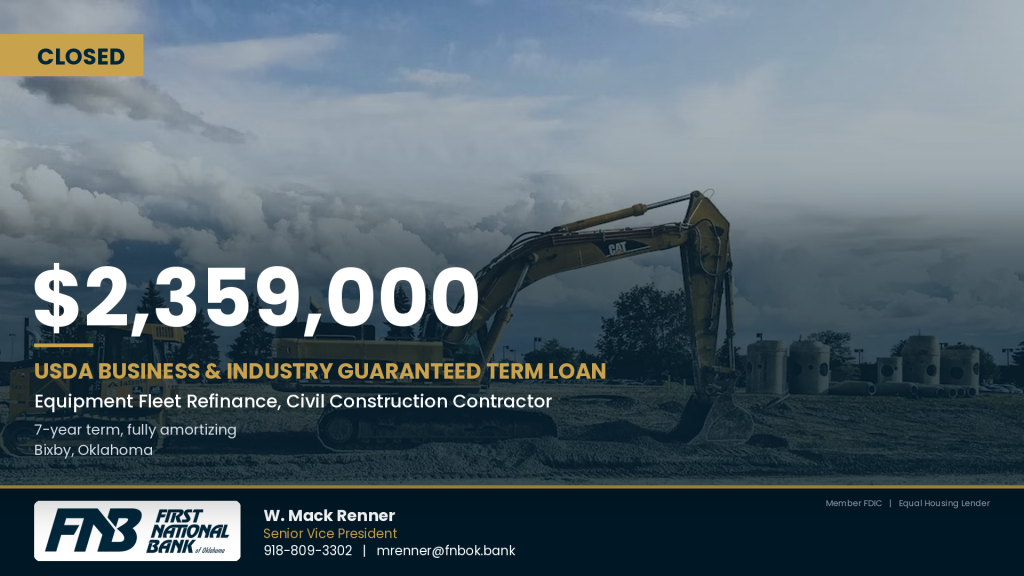
Equipment refinancing for construction companies can do more than reduce a monthly payment. With the right structure, it can free up cash flow, strengthen liquidity, and create bonding capacity for a growing business to take on larger opportunities.
First National Bank of Oklahoma recently refinanced the equipment fleet of Bixby, OK based 266 Native using a USDA Business & Industry (B&I) guaranteed loan.
For 266 Native, a Native American, woman-owned business with a growing pipeline of civil, commercial, industrial, and tribal opportunities, the financing provided longer terms and amortization than were available through its equipment vendors. That additional flexibility helped position the company for continued expansion.
Why Longer-Term Equipment Refinancing Mattered for 266 Native
266 Native is growing quickly and has recently expanded into several large commercial and industrial construction projects.
Those projects require additional equipment, which creates a familiar challenge for fast-growing contractors: growth creates opportunity, but it also creates significant capital needs.
Rather than keeping the existing equipment debt on shorter vendor-financing terms, First National Bank of Oklahoma used USDA B&I financing to refinance the company’s fleet over a longer amortization period.
That structure reduced the near-term debt-service burden and created additional free cash flow.
For 266 Native, that additional cash flow can now be directed toward purchasing the equipment needed to pursue and complete new projects.
Equipment Refinancing Can Create More Room for Growth
Construction companies rely heavily on equipment, and expanding into larger jobs often means purchasing or replacing machinery before revenue from those new projects is fully realized.
That can put pressure on working capital.
By extending the amortization of existing equipment debt, a company may be able to reduce its current payment obligations and preserve more cash inside the business.
In the case of 266 Native, refinancing the equipment fleet gave the company greater financial flexibility at an important point in its growth.
Instead of tying up as much cash in existing equipment payments, the company can use more of its operating cash flow to support new purchases, project mobilization, and expansion.
Supporting Bonding Capacity with USDA B&I Financing and Additional Liquidity
For contractors pursuing larger civil, commercial, and tribal projects, cash flow is only part of the equation.
Bonding capacity can also determine which projects a company is able to bid and ultimately perform.
First National Bank of Oklahoma paired the USDA B&I refinancing with additional liquidity through a revolving line of credit.
Together, these financing tools helped strengthen 266 Native’s liquidity position and increase its bonding capacity.
That is particularly important for a company with a robust pipeline of upcoming opportunities. Greater bonding capacity can help position a growing contractor to compete for larger projects that might otherwise be beyond its current financial reach.
Why USDA B&I Financing Can Be Useful for Equipment-Heavy Businesses
Equipment vendors often provide convenient financing, but their terms may not always align with a company’s broader growth strategy.
For qualifying businesses, the USDA Business & Industry Guaranteed Loan Program can provide an alternative structure that may allow longer repayment terms and a financing approach designed around the overall needs of the business. Even though the B&I Program is geared toward rural businesses, companies located very near major metropolitan areas still may qualify, as this transaction shows.
In the 266 Native transaction, the longer amortization was a key benefit.
The goal was not simply to refinance existing debt. It was to restructure that debt in a way that supported the company’s next stage of growth.
That distinction matters.
When equipment financing is viewed as part of a broader capital strategy, it can help a business preserve liquidity, expand capacity, and prepare for future opportunities.
266 Native Expanded Its Banking Relationship with First National Bank
The financing relationship extended beyond the USDA B&I loan.
266 Native was pleased with the terms First National Bank of Oklahoma was able to provide and moved its entire banking relationship to the Bank as part of the transaction.
That transition included the company’s depository relationship, treasury services, and online banking.
The borrower was particularly complimentary of First National Bank’s treasury team and the ease with which the depository relationship was moved. The company also highlighted its positive experience with the Bank’s online banking platform.
For a growing construction company, having lending, liquidity, treasury management, and day-to-day banking under one relationship can make it easier to manage increasingly complex financial needs.
What Growing Construction Companies Can Learn from the 266 Native Financing
The 266 Native transaction illustrates how refinancing existing equipment can become part of a much larger growth strategy.
By restructuring equipment debt and adding liquidity, a growing contractor may be able to:
- Reduce pressure on near-term cash flow
- Preserve cash for additional equipment purchases
- Support larger project opportunities
- Strengthen liquidity
- Increase bonding capacity
- Consolidate lending and treasury relationships with one financial partner
For businesses with substantial equipment needs, the question is not always simply whether financing is available.
The more important question may be whether the financing is structured in a way that supports where the company is trying to go next.
Considering Equipment Refinancing for Your Growing Business?
266 Native is one example of how USDA B&I financing can help an expanding company restructure existing debt while creating additional room for growth.
Our team at First National Bank of Oklahoma has experience using specialized financing programs such as USDA B&I to help businesses evaluate equipment refinancing, working capital needs, liquidity, and broader growth strategies.
If your company is growing, pursuing larger projects, or looking for ways to improve cash flow while continuing to invest in equipment, we’d welcome the conversation.
Contact our team today to discuss your opportunity and see whether a structure like this could make sense for your business.