
 Login
Login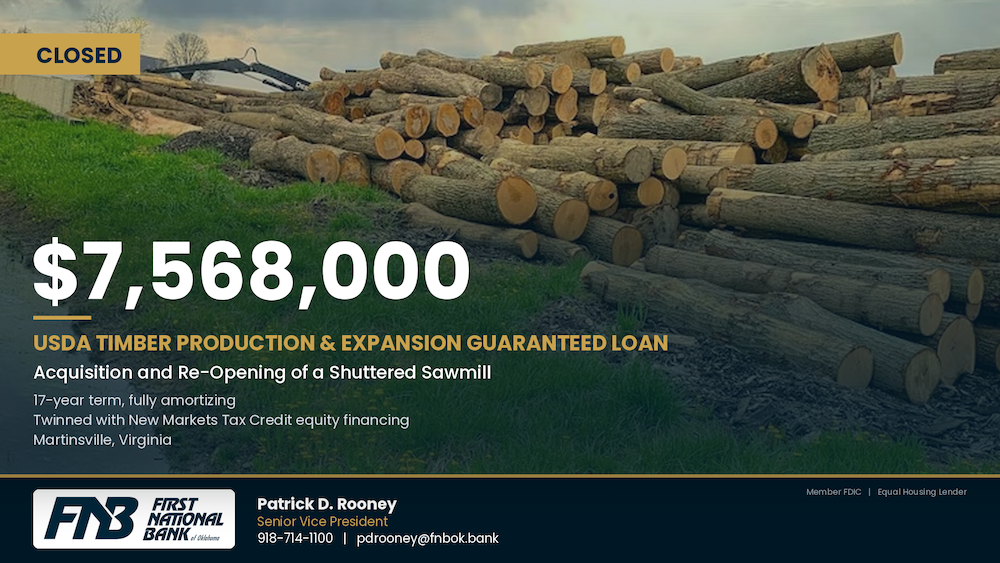
Sawmill financing can require substantial capital, particularly when the project involves bringing a shuttered facility back into production.
First National Bank of Oklahoma recently financed the Twain Lumber Company purchase of a a closed sawmill in Martinsville, Virginia, using a USDA Timber Production & Expansion guaranteed loan.
The First National financing was paired with New Market Tax Credits equity financing through the United States Department of the Treasury. Together, these financing sources created the capital structure needed not only to acquire the mill, but also to provide significant working capital for restarting operations.
For Twain Lumber Company, that means preparing to reopen a major rural employer, restore domestic lumber production, and create an estimated 50 to 100 high-paying jobs in the surrounding community.
Reopening Twain Lumber Company Means More Than Reopening a Mill
A working sawmill supports far more than the people employed inside the facility.
Once Twain Lumber Company resumes operations, its direct payroll is expected to support a broader network of businesses and workers throughout the region.
That includes:
- Logging crews
- Trucking companies
- Equipment dealers
- Forestry-related businesses
- Other local businesses supported by mill employees and activity
This multiplier effect is particularly important in rural communities, where a major employer can influence the health of an entire local economy.
Reopening Twain Lumber Company therefore represents more than a single business transaction. It has the potential to restore an important piece of the regional economic ecosystem.
Sawmill Financing Can Support Responsible Forest Management
An operating sawmill also creates an important market for local timber.
Landowners often need to thin their forests as part of responsible forest management. When nearby mills close, however, those landowners may have fewer places to sell harvested logs.
Without a viable market for timber, landowners can have less economic incentive to perform necessary thinning.
Overgrown forests can create additional challenges, including:
- Increased wildfire risk
- Greater vulnerability to invasive insects
- Reduced opportunities for responsible timber management
By reopening the Martinsville mill, Twain Lumber Company will restore a local buyer for timber and create the economic conditions needed to support responsible forest management throughout the surrounding region.
Twain Lumber Company Can Help Strengthen Domestic Lumber Supply
Domestic sawmills also play an important role in the broader housing and construction economy.
The United States imports approximately one-third of the lumber it consumes because domestic sawmill production does not currently meet total demand. Approximately 85% of those imported supplies come from Canada.
The cost of those imports has also increased.
Tariffs on Canadian softwood lumber rose from approximately 14.5% to 35% in mid-2025 and increased again to approximately 45% by the end of the year.
Those costs ultimately affect the price of lumber used in new construction and can ripple through the budget of new housing projects.
Increasing domestic sawmill capacity is therefore one way to strengthen the U.S. lumber supply and potentially reduce some of the cost pressure associated with imported materials.
By bringing the Martinsville mill back into operation, this project adds productive domestic capacity at a time when additional U.S.-based lumber production can have value well beyond the immediate community.
Why Reopening a Sawmill Requires Significant Working Capital
Buying a closed sawmill is only the beginning.
Before a reopened mill can generate meaningful revenue, the business must make substantial investments to restart production.
Twain Lumber Company will need to:
- Hire and train employees
- Acquire raw logs
- Restart production
- Rebuild work in process and finished goods inventory
- Sell finished lumber
- Carry all of those costs until finished lumber is converted into revenue
This creates a significant working-capital requirement.
Unlike an operating business that already has inventory moving through an established revenue cycle, a shuttered mill must effectively refill its entire production pipeline before sales begin catching up with expenses.
That makes sourcing financing with a major working capital component particularly important.
Combining USDA Financing with New Market Tax Credits
For Twain Lumber Company, First National Bank of Oklahoma paired a USDA Timber Production & Expansion guaranteed loan with New Market Tax Credits equity financing.
This combination allowed the borrower to close the transaction with a sizable working-capital position.
That additional liquidity gives Twain Lumber Company greater runway to:
- Staff the facility
- Purchase raw materials
- Build log inventory
- Produce finished lumber
- Manage operating expenses during the mill’s startup period
Rather than financing only the acquisition of the property and equipment, the transaction was structured with the realities of restarting a capital-intensive manufacturing operation in mind.
That distinction can be critical.
A business may successfully acquire a facility but still struggle if it lacks sufficient liquidity to operate through the period between startup expenses and the arrival of recurring revenue.
In Twain Lumber Company’s case, the combined USDA and New Market Tax Credits structure was designed to help address both needs.
What the Twain Lumber Company Deal Shows About Sawmill Financing
The Twain Lumber Company transaction demonstrates how specialized financing programs can help make complex rural industrial projects possible.
A project like this requires capital for more than real estate and equipment. The financing structure must account for startup expenses, inventory, payroll, raw materials, and the time required to establish a reliable revenue cycle.
For rural manufacturers and timber businesses, specialized financing may help address needs such as:
- Business acquisition
- Equipment and facility financing
- Working capital
- Startup and reopening costs
- Inventory requirements
- Long-term growth capital
The right structure can provide a business with enough runway not simply to close a transaction, but to successfully reach full operations.
Supporting Rural Jobs and Domestic Production
For First National Bank of Oklahoma, the Twain Lumber Company financing represents the kind of project where business financing can create a much broader impact.
The reopening is expected to create dozens of direct jobs while also supporting logging, transportation, equipment, forestry, and other businesses throughout the region.
At the same time, it restores domestic sawmill capacity and creates another market for responsibly harvested timber.
The result is a transaction that supports the borrower while also contributing to rural economic development and domestic manufacturing.
Considering Financing for a Rural Manufacturing or Timber Project?
Twain Lumber Company is one example of how USDA guaranteed financing can be combined with other specialized capital sources to support a complex rural business project.
Our team at First National Bank of Oklahoma has experience working with USDA guaranteed loan programs and structuring financing around the specific needs of rural businesses, manufacturers, and capital-intensive projects.
If you are considering acquiring, expanding, or reopening a rural manufacturing or timber operation, we’d welcome the opportunity to discuss your project.
Contact our team today to talk through your financing needs and determine what structure may be available for your opportunity.